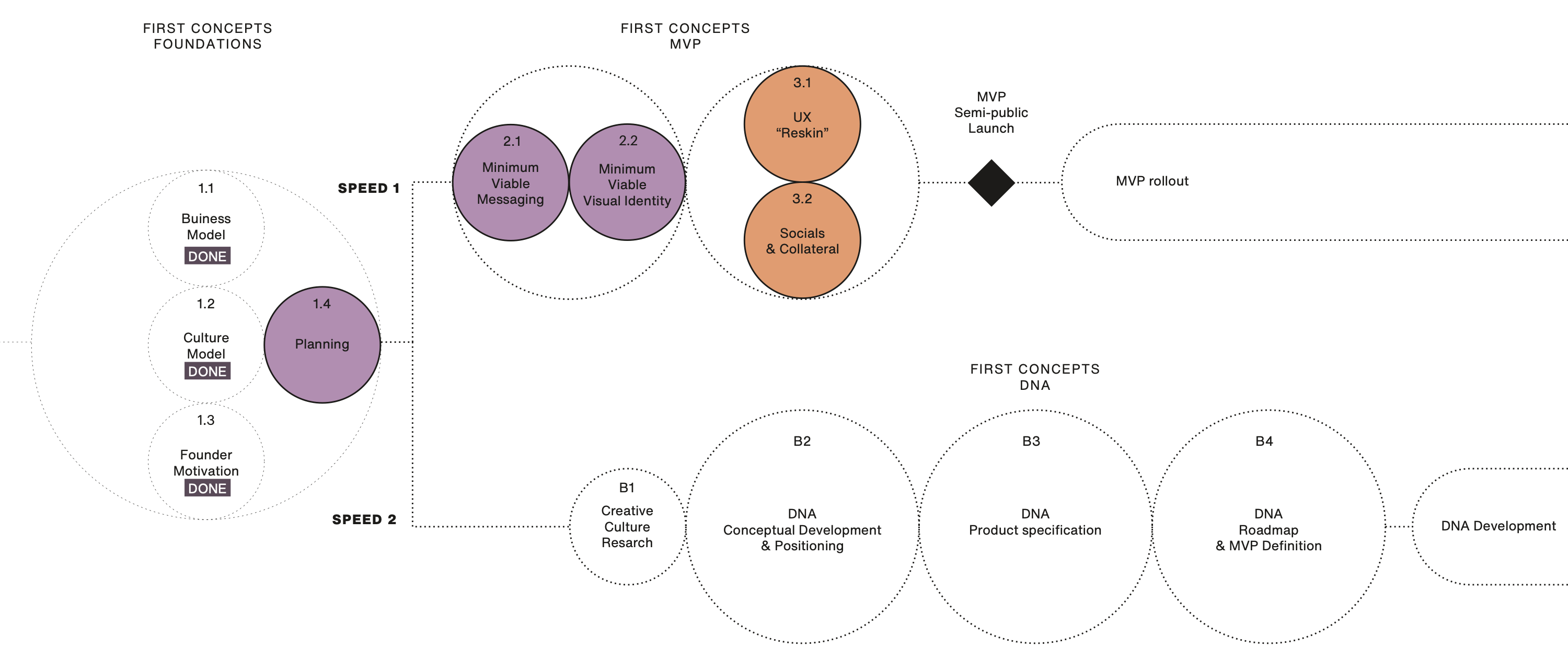
The pitch wedge pays the bills and proves the product. The conceptual flip builds the moat and changes the category. Both run simultaneously, but at different clock speeds.
Speed 1 generates the usage data, creative context, and customer trust that Speed 2 requires. Every pitch run through the system deposits material into the longer-term creative identity layer.
Speed 1 is never sacrificed for Speed 2. The pitch loop must work before the conceptual flip can matter. But Speed 2 is never forgotten — every architecture decision should make the flip easier, not harder.
Foundations
1.1 Business model — done
1.2 Culture model — done
1.3 Founder motivation — done
1.4 Planning — current
Costs
First Concepts MVP
2.1 Minimum Viable Messaging + 2.2 Minimum Viable Visual Identity
£6,000
3.1 UX "Reskin" + 3.2 Socials & Collateral
£1,000 (oversight)
First Concepts DNA
B1 Creative Culture Research
(£5,000–10,000 estimated range)
B2–B4 Conceptual development, product specification, roadmap
(£20,000–100,000 estimated range)
Speed 1 — Win the pitch
The immediate job is narrow and concrete: help creative teams go from brief to pitch-ready concept faster, without losing context or taste. This is where the pain is sharpest (agencies spending up to £200k per pitch), the workflow is messiest (tool switching, lost references, fragmented decisions), and the ROI is clearest (speed, win-rate, cost reduction). Speed 1 is about owning this moment so completely that agencies cannot imagine pitching without First Concepts.
2.1 Minimum Viable Messaging
Core brand narrative, positioning, and messaging architecture. The words that define what First Concepts is and how it talks about itself.
2.2 Minimum Viable Visual Identity
Logo, type system, colour, and the basic visual language. Enough to look credible and coherent, not a full brand book.
3.1 UX "Reskin"
Apply the new visual identity to the existing product. Interface redesign that brings the brand to life inside the tool.
3.2 Socials & Collateral
Social media presence, pitch decks, one-pagers, and launch materials. Everything needed for the semi-public launch.
→ MVP semi-public launch → MVP rollout
Prove the loop (months 1–3)
Define and instrument the pitch-concepting funnel: brief ingested → directions explored → references captured → artefacts exported → pitch delivered. Every step must be measurable. The north-star metric is time-to-first pitch-ready concept per project, with quality guardrails.
Product priorities:
- Browser extension capture: references, briefs, constraints flowing into a single project spine
- Brief → routes pipeline: 3–5 distinct directions with insight, promise, and executional territories from a seed idea
- Packaging outputs: auto-deck storyline, moodboards with reference rationale, production approach
- Critique loop: "more X, less Y" feedback that updates routes and deck consistently
- Export: pitch-ready artefacts in formats agencies actually present with
Commercial priorities:
- Founder-led sales on every call. Three pitches depending on the room: taste preservation for CDs, pitch economics for new biz leads, audit trails for ops
- Launch at £50/seat/month. Introduce pitch packs as alternative entry: per-block pricing that matches how agencies think
- Land with one pitch team per agency, expand from there
- Track AI usage costs per workspace internally (credits as accounting, not yet customer-facing)
Target: independent, pitch-heavy agencies. Mid-tier and small studios with frequent pitches and thin strategy benches. Avoid top-tier craft agencies initially — hardest to prove value, slowest to close.
Prove retention (months 3–6)
The pitch pack gets you in the door. Retention keeps you there. The question is whether teams use First Concepts between pitches, not just during them.
Product priorities:
- Project spine becomes persistent: decisions, references, and rationale carry across projects, not just within them
- Context memory v1: the system remembers brand constraints, past references, team preferences at project level. Simple, structured, useful
- Collaboration layer: roles, comments, versioning. The CD can see what the team explored and why
- Governance and audit trail from day one: every prompt, model, asset, and approval logged. Exportable as client-ready disclosure
- 1–2 deep integrations perfected (via extension) rather than many shallow ones
Commercial priorities:
- Introduce tiered plans: standard (current price, generous credit bundle), professional (higher credits, audit pack, project-level controls)
- Begin SOC 2 process — not needed yet, but the timeline must not become a blocker later
- Measure: weekly active teams, active projects/week, % using FC as both start and end point
- Write the "speed with taste intact" quality story — how humans stay in control
Prove scale (months 6–12)
From single-team pilot to agency-wide platform. The governance and audit capabilities become the enterprise wedge.
Product priorities:
- Model governance: restrict which AI models can be used per client or per project. Agencies need this — some clients mandate specific providers, some prohibit others entirely
- Agency-level context: institutional creative memory across teams, not just within them
- SSO (SAML), user provisioning (SCIM) — gated to enterprise tier
- House-style adaptation: upload example decks, infer formatting and tone. Lightweight, fast, safe
Commercial priorities:
- Enterprise tier: annual contracts, committed spend, full admin and security bundle, unlimited or high-cap seats
- Introduce the hybrid pricing layer publicly: seats + credits. Frame as flexibility, not a price increase
- AI audit pack as paid add-on or bundled into professional/enterprise — the feature that makes FC easier to procure, not harder
- Events and community: creative-thon with shared briefs, senior judges, brand sponsors. Social proof, case studies, product in the hands of the right people
Speed 2 — Build the flip
This is the deeper bet. The one that changes the category. In a world where AI commoditises execution, taste becomes the scarce resource. A creative's accumulated judgment — their references, their process, their decision-making logic, their instincts refined over years of practice — can be captured, structured, and compounded into something they own and control. Not a replacement for the person. A structured expression of how they work. This is what makes First Concepts genuinely different from every other tool in the market.
Speed 2 runs in parallel with Speed 1, but at a different clock speed. It is not the product today. It is the product that today's product makes possible. Every architecture decision in Speed 1 should be evaluated against a second question: does this make the flip easier or harder?
B1 Creative culture research
Deep research into the creative subcultures First Concepts will serve. The codes, rituals, and unwritten rules that define how creative professionals relate to their tools and identity.
B2 DNA conceptual development & positioning
Developing the creative identity concept — what it means, how it works, how to position it. The philosophical and strategic groundwork for the flip.
B3 DNA product specification
Translating the concept into product requirements. What the identity layer needs to do, how it captures and structures creative judgment, and how it integrates with the workflow tool.
B4 DNA roadmap & MVP definition
The development plan for the identity product. What gets built first, what constitutes a minimum viable version, and how it phases into the existing product.
→ DNA development
Seed the data
The conceptual flip requires structured creative data. Speed 1 generates it as a byproduct of normal use. The work here is to make sure that data is captured in a way that compounds.
- Capture preferences and constraints as structured data from the start, even in v1. Every mood board, every direction chosen over another, every "more X, less Y" refinement is a data point about taste
- Design the project spine so that decisions, references, and rationale are machine-readable, not just human-readable. The schema matters now even if the interface doesn't expose it yet
- Begin accumulating per-user patterns: which references recur, which directions get chosen, which critique language a specific creative uses. Store it. Do not surface it yet
- Ensure sovereignty architecture from day one: data belongs to the user and the agency, not to the platform. Export, deletion, and portability are not afterthoughts
Surface the pattern
Once enough projects have run through the system, the accumulated data starts to reveal creative identity. The product begins to show users what it has learned about them — gently, as a mirror, not as a prescription.
- Creative memory becomes visible: "Based on your last 12 projects, you consistently gravitate toward X. Here are references aligned with that pattern"
- Team-level taste maps: how a CD's preferences propagate through a team. Where alignment is strong and where it diverges
- Institutional coherence tools: a brand's accumulated creative standards, maintained not in a brand book nobody reads but in a system that actively flags drift
- The language must be agency-safe and opt-in. Frame as craft, not surveillance. Encoding your methodology should feel like writing a manifesto, not filling in a form
Commercialise the asset
This is the horizon. A creative's formalised identity becomes an asset in its own right — something that can be licensed, applied, and valued independently of the person's physical presence in a room.
- A CD can apply their taste consistently across every project their team touches — not by being in every meeting, but by having their methodology encoded and available as reference
- A senior designer can train juniors by giving them access to a structured version of their process and judgment, not just by sitting next to them
- A brand can preserve its institutional creative identity across staff turnover — not in a static document but in a living system
- At the far horizon: creative identity as a licensable, sovereign asset. The creative owns it. They control who sees it and how it is used. Not the platform's to harvest. Theirs to compound
- Sovereignty is non-negotiable. The creative must own their identity data completely. It cannot feel extractive. The framing is always: this is yours. You built it. You decide
- The secure architecture: a protected environment running local AI that can collaborate with the wider ecosystem while keeping identity data locked within. Context is queen — powerful, precious, protected at all costs
How the two speeds connect
Speed 1 is not a separate product from Speed 2. It is the infrastructure through which Speed 2 becomes possible. The relationship is specific:
- Every brief ingested in Speed 1 adds to the structured context that Speed 2 needs
- Every critique loop ("more X, less Y") trains the taste model that powers creative identity
- Every reference captured is a data point in the emerging map of a creative's judgment
- Every project spine preserves the decision history that makes institutional memory real
- Every audit trail proves provenance — which becomes essential when creative identity has commercial value
The founders should ask of every product decision: does this win the pitch (Speed 1) AND deposit something into the identity layer (Speed 2)? If it only does one, it should still be built if it wins the pitch. But the decisions that do both are the ones that build the moat.
The milestones
Speed 1 milestones are measured in customers and revenue:
- First 5 paying teams on real pitches
- First agency-wide deployment
- First enterprise annual contract
- Measurable time-to-pitch reduction with quality maintained
Speed 2 milestones are measured in data depth and user recognition:
- First time the system surfaces a taste pattern that surprises the user — and they say "yes, that's me"
- First team that uses institutional memory to onboard a new hire
- First creative who exports their identity profile and calls it an asset
- First conversation about licensing creative methodology
Speed 1 proves the business. Speed 2 builds the category. Both start now.