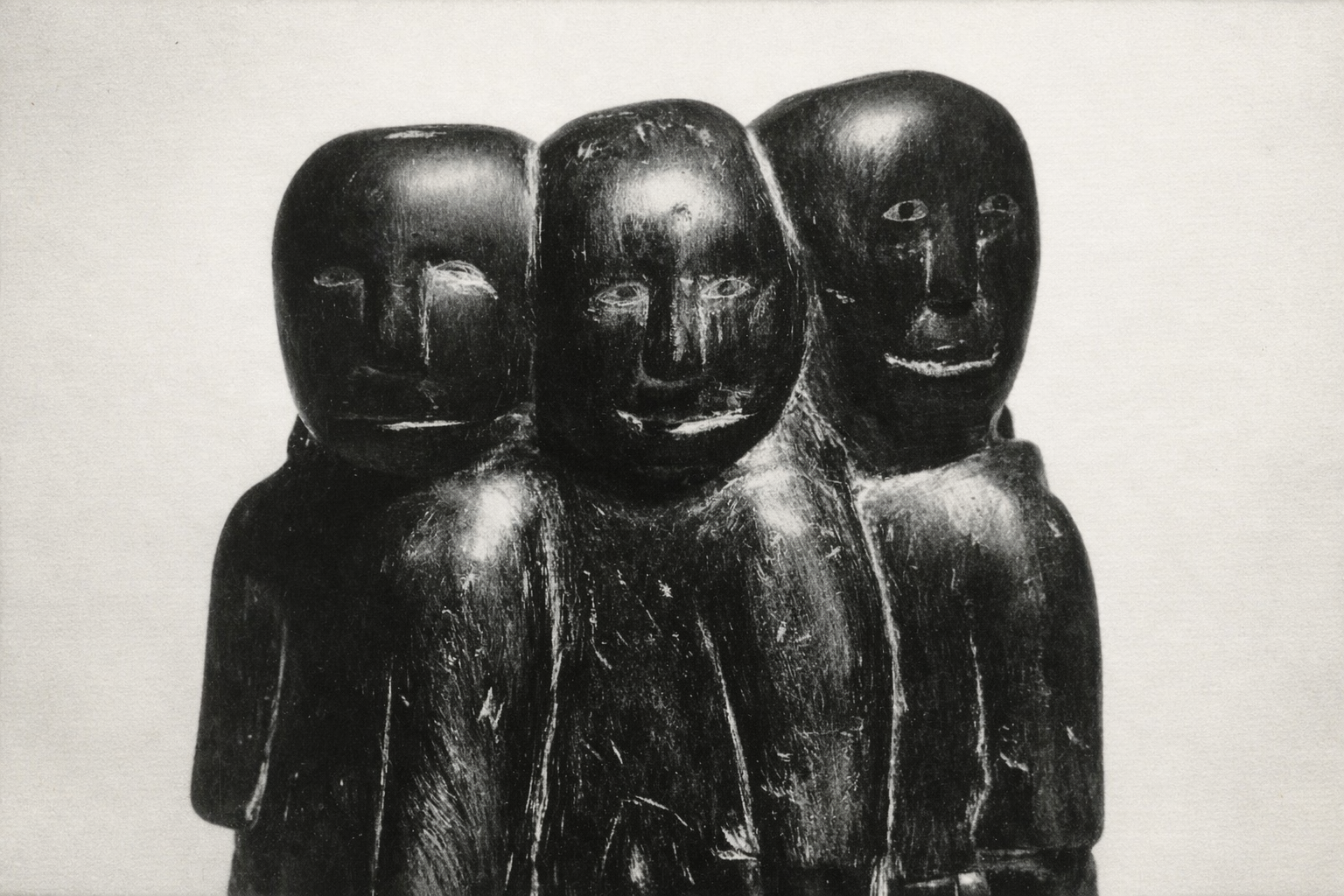
A company's culture, product instincts, and creative identity all originate in the people who started it.
We study the system: how they think, what drives them, where the energy comes from, and where the load concentrates.
A brand built authentic to its founders, that will survive contact with reality.
A system, not a team
Most founding teams are assembled. Someone knows someone. A co-founder dating market produces matches based on complementary skills, shared networks, or the logic of the org chart. You need a technical person, a commercial person, a product person. You stack capabilities until the slide looks credible to investors.
Conor, Polina, and Marin met at Antler. They were the last cohort to form a team. But something clicked immediately. Where other teams were still negotiating roles and testing chemistry, these three were already building, shipping, and flowing. The fit was not engineered. It was recognised. As Patsy put it during early advisory work: "You didn't assemble like a team. You assembled like a system."
The distinction matters. A team divides labour. A system produces something none of its parts can produce alone. In the case of First Concepts, the system works like this: Conor creates external momentum, the rooms, relationships, and narrative energy that pull the company forward. Polina creates directional coherence, the sense of what First Concepts is and is not, the meaning that keeps the product from drifting into generic AI tooling. Marin creates reality, the shipped artefact, the first-principles feasibility, the pragmatic structural thinking that turns ideas into things people can use.
This loop is the reason a three-person company out-ships teams of fifteen. Conor generates the energy, Polina directs it, Marin converts it into something real. The cycle is fast because the trust is high and the handoffs are clean. There is very little organisational friction. Decisions get made in conversations, not committees. The product moves at the speed of the founders' alignment.
But the same qualities that make the system powerful also make it fragile. The risk is not that these three will fight. It is that the system will become imbalanced, that the load will concentrate in one person until something gives. Understanding where that load sits, and why each of them carries it the way they do, is the work that follows.
Conor
Conor is the person in the room before the room exists. He is the one who makes the call, sends the message, finds the angle, and gets First Concepts into conversations it has no institutional right to be in. He is a relationship-led commercial founder in the truest sense: he does not sell a product so much as create a gravitational field around an idea, and then invite people to step into it.
His drive is not money. It is cultural proximity. Conor wants to be in the rooms where culture is shaped, and he wants to see the best creatives in the world using something he helped build. That desire is specific and revealing. It tells you that his ambition is not about scale for its own sake. It is about mattering. About being close enough to the work that he can feel it land.
Some of that urgency traces back to early loss. The imprint is legible if you know where to look: a deep, almost reflexive self-reliance. A sense that no one is coming to save you, so you had better move. This is a genuine superpower in a startup founder. It produces agency, speed, and a willingness to act before the organisation "deserves" it, before the pitch deck is ready, before the product is polished, before anyone has given permission. Conor ships and sells from conviction, not from process.
His narrative instincts are sharp. He gravitates toward images that resonate: the idea that early concepts are fragile, that most tools crack them, that First Concepts is the windshield that protects a spark long enough for it to catch. This is not marketing language he learned. It is how he actually thinks about the product. When Conor talks about what they are building, people lean in, because he believes it and his belief is infectious.
The shadows are the inverse of the gifts. The same self-reliance that makes Conor fast also makes him hard to help. "If I want it, I do it myself" is a founding virtue until it becomes "I must do it myself," and at that point the system starts to depend on a single engine. Under excitement, his focus can scatter. A new customer segment, a new geography, a new initiative, each one feels like momentum, and Conor loves momentum. But not all movement is progress, and the discipline to say no, to hold a line on what they will not pursue this quarter, is the thing he will need most as the company grows.
What Conor needs is a go-to-market system that other people can run, so that the company's commercial energy is not synonymous with his personal energy. He needs clear stop rules. And he needs, perhaps most of all, to internalise that rest and recovering is part of the engine, not a failure of will.
Polina
Polina is the person most likely to be underseen in a quick reading of the founding team. Conor is visible by nature, the energy in the room, the voice on the call, the one whose name people remember first. Marin is visible by output, the product exists because he built it. Polina's contribution is harder to photograph, but it is the reason the other two contributions cohere into something meaningful.
She is the meaning holder. Her role is directional coherence: the ongoing, often invisible work of making sure First Concepts stays true to what it is. She translates chaos into direction. She protects the product from becoming soulless. She reads what creatives will resent before the creatives have articulated it themselves. In a company building tools for people with taste, this is not a soft skill. It is the skill.
Her drive is usefulness, integrity, and the empowerment of creatives. She chooses people carefully and then commits fully. There is a seriousness to Polina that comes from having clarified, through lived experience, what actually matters. Part of that clarification came from the outsider-belonging tension of migrating young, of navigating identity across cultures and contexts, of learning to read rooms not as a social nicety but as a survival skill. Part of it came from grief, the kind that strips away pretence and leaves you with a very clear sense of what you are willing to spend your life on.
The result is a worldview that is both grounded and ambitious. Polina sees AI and human collaboration not as a slogan but as a genuine philosophical position. She holds the conviction that taste is scarce, that human judgment is the thing worth amplifying, and that tools which try to replace that judgment will be rejected by exactly the people First Concepts needs to serve. This worldview shapes the product in ways that are difficult to attribute but impossible to remove. It is the reason First Concepts does not feel like generic AI tooling.
Her gifts produce a specific shadow. Because she can absorb the emotional load of keeping things coherent, she often does. The invisible responsibility accumulates. She becomes the safety net for everyone else, the person who holds the anxiety about whether the product is true, whether the messaging is right, whether the team is okay. Her self-doubt manifests as over-accountability: if something feels off, she assumes it is hers to fix. This is useful in a three-person company. It is unsustainable in a ten-person one.
What Polina needs is explicit boundaries around what is hers to hold and what is not. She needs regular meaning check-ins that are not her solo job, a shared ritual rather than a personal burden. She needs psychological safety to say "this is too much" before she has already absorbed too much. And she needs her leadership to be visible. The pattern to avoid is the one where she is the soul of the company but is not credited as such, where everyone benefits from her judgment but no one names it.
Marin
Marin builds things. That sentence is more complete than it sounds. In a landscape saturated with founders who talk about building, who post about building, who describe themselves as builders while managing other people who do the building, Marin actually builds. He writes the code. He ships the product. He makes decisions about architecture and feasibility that determine what First Concepts can and cannot do. His hands are on the material.
His core drive is mastery, buildability, and an ethical constraint that runs deeper than corporate responsibility language usually reaches. He wants people to love the product daily, and he does not want to make the world worse. These two commitments shape his technical decisions in ways that are easy to miss if you are only looking at the output. The product is fast and pragmatic not because Marin does not care about elegance, but because he cares more about usefulness. He will cut opulence to reach product-market fit. He will choose the consistent technology if the consistent technology ships.
His coherent product thesis, the sentence that best captures his thinking, is: taste remains when low-value execution disappears. This is not a marketing line. It is an engineering principle. It tells Marin what to automate and what to leave to humans. It tells him where AI adds value and where it destroys it. It is the technical expression of the same worldview Polina holds philosophically.
The pragmatic structural thinking comes, in part, from balancing complexity early, from navigating two households, from learning to hold contradictions without forcing resolution. He has a deep maker identity that extends beyond code into music and craft. He is calm under pressure, non-dramatic, and reliable in the way that quietly competent people are reliable: you do not notice the contribution until you imagine its absence.
The shadows are predictable and serious. Marin fixes alone. He works through problems with late visibility, surfacing the solution but not the difficulty. This means the rest of the team, and eventually the rest of the company, does not have an accurate picture of where the technical complexity lives, what is brittle, what is expensive, what would force a rewrite. The risk is a scaling cliff: AI-generated code with low review, an integration-heavy system held together by one person's understanding, and no engineering narrative to guide hiring decisions.
His communication avoidance is the flip side of his competence. "I'll just build it" is the most efficient sentence in a three-person startup and the most dangerous one in a fifteen-person company. What Marin needs is earlier surfacing of complexity, not as a burden but as a practice. A weekly reveal of what is brittle, what is unknown, what is risky. He needs a hiring plan that reduces single-point-of-failure dependence on him. And he needs permission, which he is unlikely to ask for, to slow down in order to make future speed possible.
How might the system fail?
The failure mode is unlikely to be a blow-up — Conor and Polina disagreeing about strategy, or Marin refusing to build something. The three of them are genuinely aligned on what matters. The failure mode is quieter and more insidious: imbalance.
Conor, because he is wired for momentum and because his self-reliance runs deep, gradually becomes the only commercial engine. Every key relationship runs through him. Every pitch depends on his energy. Every new opportunity is a function of his personal network and personal charisma. The system does not notice this as a problem because it looks like success. Conor is winning deals. Conor is opening doors. Conor is generating excitement. But if Conor gets sick, or tired, or burned out, or simply needs a week off, the entire commercial function of the company pauses. Momentum is not a system. It is a person. And that is the first crack.
Meanwhile, Polina is absorbing. She is holding the emotional and directional weight of making sure the product stays coherent, the messaging stays true, and the team stays aligned. She is doing this because she is good at it and because no one else is doing it. The load is invisible because it does not produce visible artefacts: there is no spreadsheet for "kept the company's soul intact this week." She does not complain because her instinct is to take responsibility, not to distribute it. Over time, the joy drains out. The work becomes obligation. The quiet resentment that follows is not directed at Conor or Marin. It is directed at a structure that does not see what she carries.
And Marin is fixing. Alone, late at night, with the kind of focused competence that solves today's problem while creating tomorrow's. The codebase grows more complex. The architecture accumulates decisions that only he understands. When something breaks, he fixes it before anyone knows it broke. This feels like reliability, and it is, right up to the point where the complexity exceeds one person's capacity to hold it. Then it becomes fragility, and the transition is abrupt.
This pattern, not conflict but concentration, is the tripwire. It is the thing that rituals, hiring, and honest conversation need to protect against. The question is never "do they trust each other?" They do. The question is "does the system distribute load in a way that is sustainable?" Right now, the answer depends on whether they build the structures to make it so.
The stories they should tell
Every company has a mythology, whether it chooses one or not. The question is whether the stories that circulate about you are the ones that serve you, the ones that are true to who you are and what you are building, or whether they are the generic founder narratives that investors and journalists default to when they do not have anything better.
First Concepts has four narrative engines that are already present in how the founders talk and think. They do not need to be invented. They need to be recognised, sharpened, and deployed.
The first is The Windshield. This is Conor's image, and it is powerful because it is visceral. Early ideas are fragile. Most tools, most processes, most meetings crack them. First Concepts is the windshield that protects a spark long enough for it to catch. This is a product landing page. This is the opening of a keynote. This is the voiceover on a brand film. It works because it names a feeling every creative knows: the moment when a nascent idea meets the machinery of production and dies. First Concepts promises that it will not let that happen.
The second is Taste Is What's Left. This is Marin's thesis translated into a worldview. When AI strips away low-value execution, when the mechanical parts of creative production become free, what remains is taste. Judgment. The ability to know what is good. First Concepts is not a generator. It is a taste amplifier, a taste translator inside teams. This narrative works for thought leadership, for hiring, and for investor conversations. It positions the company on the right side of the anxiety that every creative professional feels about AI, not as a replacement for human judgment but as the thing that makes human judgment more visible and more valuable.
The third is A System, Not a Team. Patsy's observation becomes a founding myth. First Concepts is built by a system that mirrors the product: momentum, meaning, and reality. Three forces in a loop. This story is useful for the founder page, for recruiting, and for internal alignment. It tells potential hires what kind of company they are joining: not a hierarchy, not a flat democracy, but an interdependent system where each person's contribution is distinct and necessary.
The fourth is Creative DNA. This is the longer-term narrative, the compounding moat. Over time, First Concepts becomes the place where a team's creative judgment accumulates. The more you use it, the more it understands your taste, your process, your patterns of decision-making. The work gets more yours with every project. This is a powerful story, but it needs careful handling. The language must be agency-safe and opt-in. Creative professionals are rightly suspicious of anything that sounds like surveillance or extraction. The framing should emphasise ownership: this is your DNA, your fingerprint, your accumulated taste. Not ours to harvest. Yours to compound. This narrative is not for early marketing. It is for the moment when the product has proven itself and the conversation shifts from "what does it do?" to "why does it get better?"
These four stories are not interchangeable. Each serves a different context and a different audience. The Windshield is emotional and immediate: use it when you need someone to feel something. Taste Is What's Left is intellectual and positioning: use it when you need someone to think differently about AI. A System, Not a Team is structural and revealing: use it when you need someone to understand the founding dynamic. Creative DNA is visionary and long-term: use it when you need someone to see the ten-year picture.
The common thread is that all four stories are true. They are not aspirational branding. They are descriptions of how these three people actually think, what they actually believe, and what they are actually building. The best company mythologies are the ones that do not require performance. They just require recognition. Conor, Polina, and Marin already have the stories. The work now is to tell them clearly, consistently, and in the right rooms.